Street and Neighborhood Vocabulary for Kids
Street and Neighborhood Vocabulary and Activities for Kids teaches local places, road features, directions, and safe movement. Begin with familiar words such as street, park, and shop, then add across from and turn left. Help your child notice their surroundings, follow directions, and describe routes in English.
Core Words and Useful Phrases
Start with recognisable places: house, apartment, school, shop, bakery, pharmacy, library, park, playground, and bus stop. Teach street features and direction words in groups:
Teach six to ten items through a real route or map. Add words when your child can point to, act out, or use most of the first set. Street and Neighborhood Vocabulary and Activities for Kids combines nouns, actions, and positions: “Walk past the bakery” teaches more than bakery alone.
Using Neighborhood Words in Context
Build sentences from visible places: “The park is next to the library.” “The bus stop is across from the shop.” “We turn right at the corner.” Younger children can point while an adult speaks, then complete the final word or repeat the sentence.
Move from recognition to speech with questions: “Where is the playground?” or “How do we get to the bakery?” A beginner may progress from “There” to “It is near the school.” An older child can sequence directions: “Go straight ahead, pass the pharmacy, and turn left at the traffic lights.”
Show regional differences without marking either form wrong. Families may hear sidewalk or pavement, crosswalk or zebra crossing, and apartment or flat. Practise one form and explain the alternative when it appears in books, videos, or conversations.
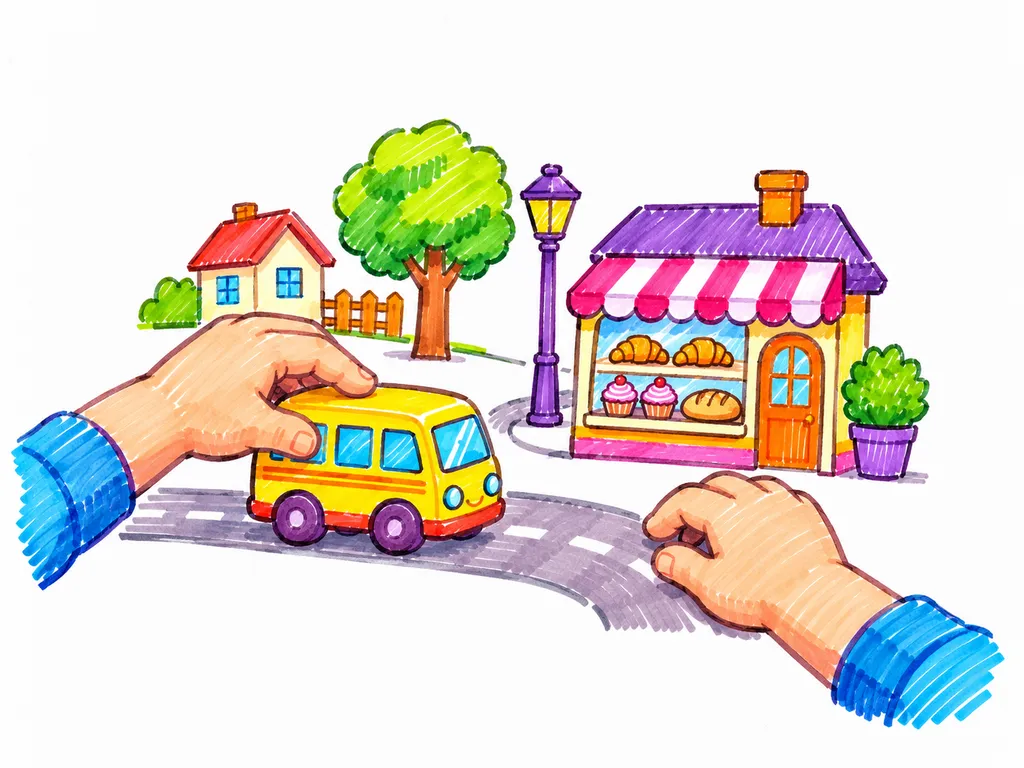
For children, use a three-step map routine: name a starting place, choose a destination, and describe the route in two or three sentences. Place six picture cards on the table and move a toy figure along the streets. After each direction, the listener moves the figure; if it reaches the wrong place, the speaker changes one instruction rather than starting again.
Watch for a common mistake: learners often omit the in phrases such as “next to the bank” or confuse in front of with opposite. Give four quick contrasts using the same map: “The café is in front of the station” and “The café is opposite the station.” Ask the child to point first, then say the full sentence without a model.
Activities for Different Ages
Street and Neighborhood Vocabulary and Activities for Kids should match each child’s attention span and speaking level. A four-year-old may sort pictures and follow one-step directions. A nine-year-old can plan and explain a route. Older learners can compare areas, discuss transport, or design a safer street.
For multilingual children, connect each English word to a known concept. Your child knows what a pharmacy is; they need its English label and practice. Accept a home-language word when needed, supply the English form, and continue.
During walks, separate language practice from safety decisions. An adult chooses where and when to cross. Ask your child to name places or repeat directions only where stopping and talking is safe.
Simple Practice at Home and Online
Draw four roads and six local places on paper. Place a coin or toy on the map. Ask, “Where is the library?” Answer with a position phrase. Then give a route: “Go along Green Street, turn right, and stop next to the park.” Change one detail each round.
Five-minute Route Challenge
Place a toy at the school and choose a destination. Give three directions without pointing. Your child moves the toy and names its finishing position. Revise an unclear instruction together, then swap roles.
Street and Neighborhood Vocabulary and Activities for Kids can become a speaking routine during online lessons at LearnLink. Our tutors model phrases, check understanding, and vary practice with questions, maps, and role play. Repeat the language on different routes at home so it transfers beyond one worksheet.
For children, practise in sets of six words: three places, two street features, and one direction phrase. Show a simple map for 20 seconds, cover it, and ask the child to rebuild the route with cards or toys. This retrieval step is more useful than copying labels. After two rounds, replace the pictures with written place names and ask for a complete sentence.
Listen for a common mistake: children may say “turn to right” or omit “the” in “on the left.” Use recasting rather than stopping the game: repeat the correct phrase naturally, then invite the child to give the direction again. With ages 10–12, add a reason or landmark—“Turn left after the café because the museum is opposite the bank”—and score one point for accuracy and one for clear pronunciation.
Common Mistakes and How to Correct Them
Children often omit words in position phrases: “next the park” instead of “next to the park,” or “opposite from the school” instead of “opposite the school.” Respond with the complete phrase: “Yes, the shop is next to the park.” The correction models English without interrupting conversation.
Street and road are not always interchangeable, and local names follow no perfect rule. Teach the actual name, such as “King Street.” As a working contrast, streets often have buildings along them, while roads connect places.
Left and right require physical practice. Face the same direction as your child or mark one hand with a removable sticker. Practise “turn left” through movement before map work. If a mistake changes the route, let the toy reach the wrong place and ask your child to repair the instruction.
- Choose five street and neighborhood words, model each pronunciation, then invite repetition.
- Draw a simple neighborhood map, label four places, and correct spelling gently.
- Read one picture-book page, identify locations, and replace vague words together.
- Role-play asking for directions twice, switching roles and correcting one error afterward.
- Review five cards, sort street objects from neighborhood places, and explain choices.
When a word has several meanings or pronunciations, Cambridge Dictionary is a useful check before turning it into child-friendly examples.
Frequently Asked Questions
How Many Neighborhood Words Should a Child Learn at One Time?
Begin with six to ten words from one familiar route or map. Street and Neighborhood Vocabulary and Activities for Kids becomes easier when the words connect. Add three or four new items after your child can recognise the first set and use it in short phrases.
Should We Teach British or American Street Vocabulary?
Choose the variety your child encounters most, then introduce alternatives as they arise. A child can use sidewalk while understanding pavement. Consistent practice builds confidence, while awareness of both forms supports understanding across speakers and materials.
What If My Child Understands Directions but Does Not Speak?
Accept pointing, moving a toy, or choosing a picture. Then offer a sentence frame such as “The park is ___ the school.” Speech may begin with one missing word. Wait until your child understands the pattern before requesting a full answer.
How Often Should We Practise Neighborhood Vocabulary?
Practise briefly several times across the week. Five minutes with a map, a question during a walk, or one route game provides review. Reuse phrases in new settings: a child who knows “next to” on paper may need practice outdoors.
If your child needs steady speaking practice, start small — choose a trial lesson.
Stay updated on our latest tips and resources by following us on Instagram LearnLink.